
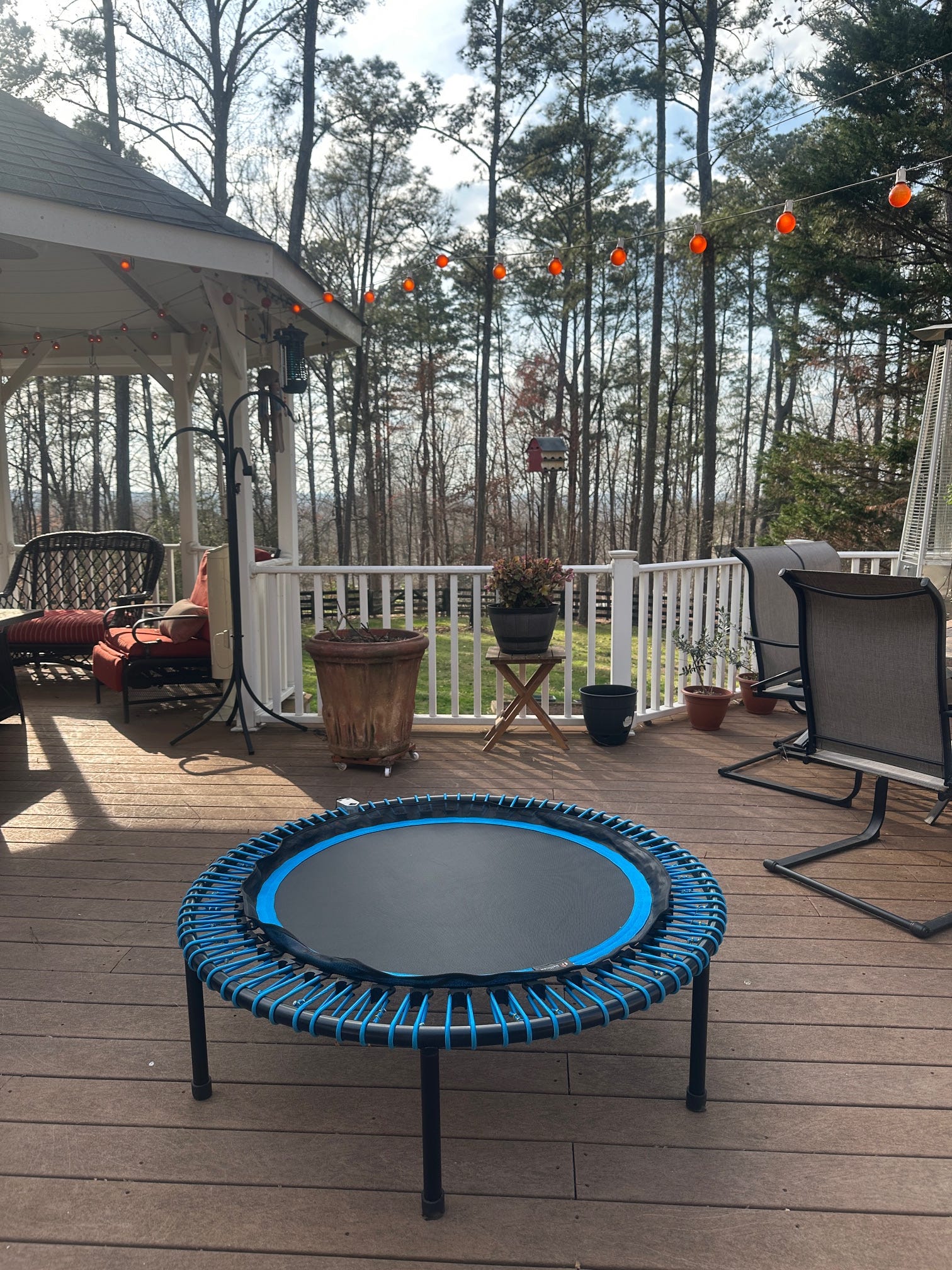
While none of my neighbors can see me, if they could they might reasonably conclude I’ve lost my mind. Each morning I turn on 1970s disco music, step onto a rebounder on my deck, and start bouncing.
It probably looks ridiculous.
But over time I’ve come to believe this simple habit may be one of the most underrated forms of movement for long-term health. Rebounding also lets me stack another habit at the same time. While I’m bouncing on the deck, I’m soaking up the morning and/or evening sunlight and getting a healthy dose of the sun’s red and near-infrared rays.
Here’s why I do it:
1. Rebounding stimulates the lymphatic system
Unlike the cardiovascular system, the lymphatic system has no pump.
Lymph fluid relies largely on muscle contraction and body movement to circulate. This fluid carries immune cells, metabolic waste products, and inflammatory debris away from tissues.
Gentle vertical acceleration - like the up-and-down motion of rebounding - appears particularly effective at stimulating lymph flow.
Early NASA work examining different exercise modalities noted that rhythmic bouncing movements produced strong lymphatic circulation with relatively low joint stress.
In practical terms, that means rebounding helps support:
• immune function
• detoxification pathways
• tissue fluid balance
While formal lymph-flow studies are limited, the biomechanics make intuitive sense. The shifting G-forces created by bouncing likely generate a gentle compression that helps move cellular waste out of tissues.
2. It is an unusually efficient cardiovascular exercise
Rebounding creates repeated cycles of acceleration and deceleration.
With each bounce, the body experiences small shifts in gravitational force. These shifts require constant engagement of stabilizing muscles and cardiovascular adjustments.
Studies comparing rebounding to treadmill running have found that rebounding can produce similar oxygen consumption with significantly lower impact forces.
That makes it appealing for:
• older adults
• people with joint issues
• those seeking low-impact aerobic exercise
In other words, you can achieve meaningful cardiovascular stimulation without pounding your joints.
3. It activates muscle and bone without high impact
Every bounce involves rapid cycles of:
• muscle contraction
• eccentric loading
• stabilization
These small forces repeatedly stimulate:
• postural muscles
• lower-body muscle fibers
• bone mechanoreceptors
Mechanical loading - even at modest levels - is one of the key signals that helps maintain bone density and muscle function with age.
Because rebounding distributes force across the trampoline surface, the impact is much lower than running or jumping on hard ground.
4. It may support metabolic health
Like other rhythmic aerobic activity, rebounding improves:
• circulation
• insulin sensitivity
• mitochondrial activity
But it also has an additional advantage: it is easy to do frequently.
Many people struggle to fit longer workouts into daily life. Rebounding allows you to accumulate meaningful metabolic movement in short bursts throughout the day.
Even five to ten minutes of rhythmic movement can improve glucose handling after meals.
5. It appears to improve balance and coordination
The unstable surface of a rebounder requires constant micro-adjustments of posture and balance.
These adjustments engage:
• core muscles
• stabilizing muscles of the hips and ankles
• proprioceptive feedback systems
Maintaining these systems becomes increasingly important as we age.
Balance training is strongly associated with fall prevention and long-term mobility.
6. Possible brain benefits
Direct research on rebounding and brain health is limited, but several mechanisms suggest potential benefits.
Rhythmic aerobic movement increases:
• cerebral blood flow
• neurotrophic signaling (such as BDNF)
• metabolic flexibility
Exercise also improves glymphatic clearance, the system the brain uses to remove metabolic waste during sleep - great for APOE4 carriers!
Rebounding may add an additional element: mild gravitational variation, which some researchers believe can influence fluid dynamics in the brain and spinal system.
This area remains largely speculative, but it is biologically plausible.
Why I do it
For me, rebounding checks several boxes at once.
It is:
• low-impact
• metabolically stimulating
• easy to do daily - and more than once
• surprisingly energizing
and FUN!
Ten minutes of bouncing is often enough to increase heart rate, improve circulation, and start the day with movement. I often add 3-5 lb weights.
Most importantly, it is something I can maintain consistently.
And consistency matters far more than perfection. In case you wonder, the rebounder I use is a 44” diameter Bellicon.
Addendum: The Astronaut / Neurology Insight
Researchers studying astronauts found that rhythmic vertical acceleration changes how cerebrospinal fluid moves through the brain and spinal canal.
In microgravity, CSF circulation becomes abnormal, which is one reason astronauts sometimes develop vision changes and intracranial pressure problems.
On Earth, rebounding produces repeated mild acceleration and deceleration forces that affect the same fluid dynamics.
The effect:
• alternating pressure gradients in the spine
• improved CSF pulsation
• improved venous drainage from the brain
These factors influence glymphatic flow.
Why This Matters for Brain Detox
The glymphatic system clears:
beta-amyloid
tau proteins
metabolic waste
It works best when:
• CSF circulation is strong
• venous drainage is unobstructed
• lymphatic vessels in the neck are active.
Rhythmic body movement helps all three.
Why Rebounding Is Particularly Effective
Rebounding creates a unique combination:
Acceleration + decompression cycles
When you bounce:
Downward force
→ pushes lymph and venous blood upwardUpward release
→ reduces pressure and allows refill
This acts like a pump for lymph and venous return, which indirectly improves CSF exchange.
NASA researchers noted that rebounding can stimulate circulation more efficiently than running with lower oxygen demand.
A Simple “Brain Clearance Bounce”
You can add this small sequence after your rebound session.
2–3 minutes
1️⃣ Gentle bounce
2️⃣ Slow nasal breathing
3️⃣ Relax shoulders and neck
Then add:
30 seconds
Look slightly upward and gently extend the neck.
This position opens the jugular venous drainage pathways, which are critical for brain waste removal.
Why Neck Position Matters
The brain clears waste through:
• jugular veins
• meningeal lymphatic vessels
These run through the neck.
Poor posture or tight neck muscles can reduce drainage.
The gentle rebound + upright posture encourages venous outflow from the brain.
I bought my first rebounder in 2021 and wore it out. Now working on wearing out my second one. I also do inversion for 6 to 10 minutes, often before or after my rebounding.
Hi Karin, I love my rebounder that I bought at your suggestion. Thank you ! Wondering if you have a special routine…? And do you do actual jumping versus stepping…I’ve been walking in place fast, but think I might need to “step it up” with what Im doing on it for maximal benefit…and yes pun intended …..:)