
Most people think of cells as bags of watery soup with proteins floating around randomly. But that’s not how biology actually works.
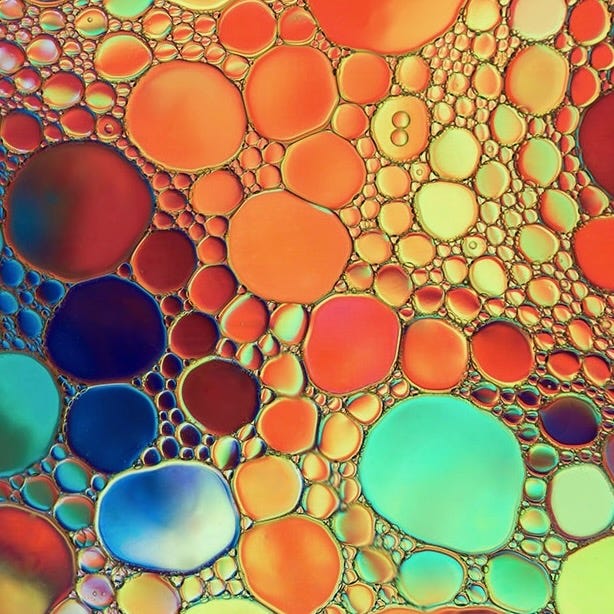
Inside every cell is a hidden system that organizes life using the same physics we see when oil separates from water. Scientists call this phase separation, and it turns out to be one of the most important discoveries in understanding Alzheimer’s disease — especially for those of us with APOE4.
Here’s the simplest way to understand it:
1. Proteins behave like liquids — not rigid objects
Clifford Brangwynne (Princeton) discovered that many structures inside the cell are not “solid.” They behave like droplets — little liquid bubbles inside the cell.
These droplets help proteins stay organized, flexible, and functional.
Think of them like tiny gelatin bubbles that keep the cell tidy and running smoothly.
2. Healthy proteins constantly move between two states
Proteins naturally switch between:
Liquid state → flexible, moving, dissolving
Gel-like state → slightly thicker, more structured
This switching is normal and essential. It’s how our cells organize work, just like rearranging items on a desk.
3. But stress, aging, inflammation, or genetics (like APOE4) can “push” proteins too far
Sometimes, the droplets harden.
They stop being liquid.
They turn into sticky gels, and then eventually solid clumps.
That’s the moment phase separation becomes dangerous. (or, as Doris Loh refers to in her many melatonin discussions, this is when phase separation becomes aberrant.)
Hardened droplets can turn into:
Tau tangles
Amyloid plaques
TDP-43 aggregates
These are the exact proteins that drive Alzheimer’s, Parkinson’s, and other neurodegenerative diseases.
4. Alzheimer’s is partly a problem of droplets turning into thick sludge.
This is the key idea:
Alzheimer’s is not just about “too much amyloid” — it’s about proteins losing their liquid flexibility and becoming stuck.
If the cell can’t keep proteins in their healthy liquid state, the system becomes clogged — like a kitchen sink filled with hardened grease.
This concept explains:
why aging increases risk
why inflammation makes things worse
why stress granules “freeze” under chronic stress
why APOE4 brains accumulate sticky proteins earlier
It’s not just about quantity; it’s about phase — liquid vs solid.
5. The hopeful part: phase separation can be influenced
This is where the field is exploding with optimism.
Many interventions some of us already use support the “liquid state” and protect against harmful hardening:
✔️ Melatonin
Powerful regulator of protein folding, mitochondrial protection and autophagy.
✔️ Red light therapy (PBM)
Supports mitochondria → reduces cellular stress → stabilizes healthy liquid droplets.
✔️ Omega-3 DHA & phosphatidylcholine
Keep membranes fluid; reduce “stickiness” of proteins; improve synaptic repair.
✔️ Ketones & metabolic flexibility
Reduce oxidative stress → fewer proteins pushed into hardened states.
✔️ Exercise
Upregulates heat-shock proteins that literally function as “protein lifeguards.”
✔️ Good sleep
Protects protein clearance and prevents stress-granule hardening.
In other words — there are many things that help proteins stay liquid, flexible, and non-toxic.
6. Why APOE4 matters here
APOE4 affects lipid metabolism and cellular stress handling.
APOE4 brains have:
higher baseline inflammation
impaired lipidation
more stress granules
more rapid collapse from liquid → solid states
impaired cleanup systems (autophagy, lysosomes)
This makes phase separation more fragile in APOE4 individuals — and more important to protect.
7. The big picture
Phase separation is the physics that underlies Alzheimer’s.
If proteins stay in their liquid, dynamic state, the brain remains healthy and resilient.
If they harden into clumps, cognitive decline accelerates.
This is why a good protocol of sleep, melatonin, red light, DHA, fasting window, autophagy support, mitochondrial repair — is not fad wellness.
It is directly targeting the physics behind neurodegeneration. All of the above is already part of my protocol. How many of you are incorporating these tools in your prevention program?
https://pubmed.ncbi.nlm.nih.gov/38167731/
https://pubmed.ncbi.nlm.nih.gov/35181198/
https://pubmed.ncbi.nlm.nih.gov/36702317/
I do all of these things but I’m still confused on diet. I eat low saturated fat diet with oats, beans and sweet potatoes. I only eat sardines and salmon for my protein. Should I ditch the carbs and eat mono and polyunsaturated fat ketogenic diet?