
Before getting into this week’s article about Vielight, I wanted to explain my silence since October 1st! My husband and I have just returned from Europe, where we finally checked Vienna, Austria, off our bucket list. Between the wonderful museums, palaces, gardens and concerts, there was plenty to explore - and plenty to stimulate my brain!
It was a lovely reminder that caring for our brains can also mean stepping away from our routines, discovering new places and enjoying life. Now that I’m home, I’m ready to explore the research behind another approach to brain health: Vielight.
As an APOE4/4 carrier, my curiosity piqued when I kept seeing the 40hz Vielight and Neuronic devices advertised last year. After much research, I finally purchased the Vielight Alpha/Gamma a year ago. Since then, I use Vielight as part of my approach to brain health.
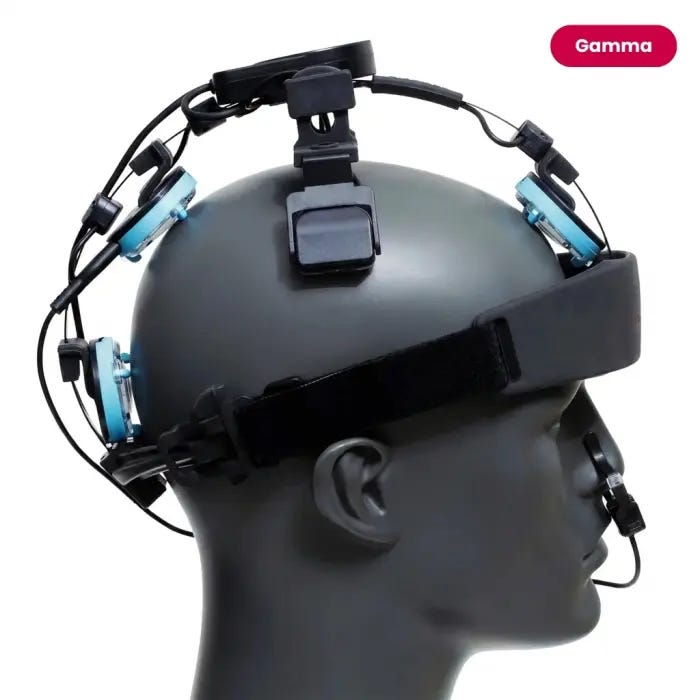
I’ve been thinking that some of you might be wondering about the research and the benefits of this helmet, so I dug a little deeper to fill you in. What have researchers actually measured? Were participants compared with a placebo? And how far can we reasonably carry the findings?
The published research offers reasons for interest. Small human studies have reported improvements in cognitive testing, changes in brain connectivity, and increased cerebral blood flow. A randomized, sham-controlled study published in June 2026 adds another piece of evidence. These findings deserve attention and a careful look at what each study can establish.
What does “40 Hz” mean?
The Vielight Neuro Gamma delivers near-infrared light at a wavelength of 810 nanometers, pulsed 40 times per second. The wavelength describes the light itself; 40 Hz describes how frequently it switches on and off. The device combines scalp-mounted lights with an intranasal applicator.
Two ideas underpin the research. Photobiomodulation investigates whether light can influence cellular processes, including mitochondrial energy metabolism. Gamma-frequency stimulation investigates whether stimulation can influence brain rhythms and communication between regions.
Those ideas overlap, but an important question remains: how much of any benefit specifically depends on the 40 Hz pulse rate?
Vielight and MIT’s light-and-sound research are different treatments
Many readers will have encountered research from MIT using visible flickering light and rhythmic sound at 40 Hz. That approach stimulates the brain through the visual and auditory systems. Vielight applies near-infrared light through the scalp and nose.
The shared frequency makes comparison interesting. It does not make the evidence interchangeable. A result from a light-and-sound experiment cannot automatically be attributed to a near-infrared headset.
The 2019 dementia pilot: encouraging results in eight people
Linda Chao’s study randomized eight people with dementia to either usual care or home treatment with the Vielight Neuro Gamma. Four received treatment three times weekly for 12 weeks; four continued usual care.
The treatment group showed improvements in:
Cognition, measured with the ADAS-Cog.
Behavioral and psychological symptoms, measured with the Neuropsychiatric Inventory.
Cerebral blood flow.
Connectivity between selected regions within the default mode network.
The cognitive comparison was statistically significant, with a reported p value of 0.007. No adverse side effects were reported.
What makes this study interesting is that researchers measured both clinical outcomes and brain imaging. The findings went beyond participants saying they felt better.
However, only four people received active treatment, and the comparison group did not use a sham headset. Expectations, caregiver attention, and other differences between groups therefore remain possible influences. A study this small can identify a promising signal; it cannot reliably tell us how much benefit the average patient should expect.
The 2019 EEG study: evidence that the device affects brain activity
A separate randomized, double-blind, sham-controlled crossover study examined 20 healthy participants following a single Neuro Gamma session.
Researchers reported changes in EEG power, connectivity, and synchrony. These included increased activity in higher-frequency bands—alpha, beta, and gamma—and reductions in slower delta and theta activity.
This supports a physiological effect. It does not establish improved memory, removal of Alzheimer’s proteins, or protection against dementia. Changes in gamma-band activity also should not automatically be described as proof of precise, sustained 40 Hz entrainment throughout the brain.
The 2026 MCI trial: a stronger comparison, still a small study
Published in the Journal of Alzheimer’s Disease, this randomized, single-blind pilot assigned 20 adults with mild cognitive impairment to active treatment or sham.
Participants used the device at home for 20 minutes, six days weekly, for six weeks. Compared with sham, active treatment produced greater improvement in global cognition on the MMSE and long-delay recognition memory on the California Verbal Learning Test-II.
Researchers also reported increased default mode network connectivity, lower plasma IL-6, and changes in blood lactate and pyruvate. The cognitive effect sizes were large—approximately one standard deviation—but estimates from small pilots can be unstable.
Adherence exceeded 94% in both groups. Adverse events occurred in four active-treatment and six sham participants; none were serious.
The combination of cognitive, inflammatory, metabolic, and imaging findings makes this study worth following. Nevertheless, blood metabolic changes are indirect evidence: they do not directly measure energy production inside brain cells. Lower circulating IL-6 does not, by itself, establish reduced inflammation within the brain.
Nor can a six-week study tell us whether improvements persist, preserve independence, or reduce progression to dementia.
An easily missed fact: an early Vielight study used 10 Hz
The frequently cited 2017 Saltmarche case series involved five people with dementia and used 810-nanometer light pulsed at 10 Hz.
It belongs in the history of Vielight research, but it should be labeled accurately when discussing the 40 Hz Gamma device.
This distinction also exposes a gap in the evidence. An active-versus-sham comparison tests a treatment package. Establishing whether 40 Hz is superior to 10 Hz or continuous light requires direct comparisons with appropriately matched doses.
What happened to the larger Alzheimer’s trial?
Vielight’s research page describes a pivotal trial with a planned enrollment of 228 participants. Planned enrollment should not be confused with the number who completed treatment.
The ClinicalTrials.gov record available when I checked listed that trial, NCT03484143, as suspended, citing slow recruitment and consideration of protocol changes. The record’s last posted update was January 2023, and it listed no results. An old registry entry cannot establish what may have happened subsequently, but it does mean we should not cite this as a completed, successful 228-person trial.
What does this mean for APOE4 carriers?
For those of us thinking about prevention, the distinction between treating existing impairment and preventing future disease matters enormously.
The studies discussed here do not establish that Vielight prevents Alzheimer’s in cognitively healthy APOE4 carriers, that APOE4/4 carriers respond differently, or that it reduces amyloid or tau pathology. Their findings concern short-term cognitive performance and physiological measures in particular study populations.
The next useful trials need larger samples, stronger blinding, longer follow-up, and outcomes that matter in daily life. They also need to clarify whether any benefit depends on pulse frequency, disease stage, or genotype.
I find the existing results encouraging enough to keep following closely and using my Vielight a few times weekly. My personal decision to use Vielight sits alongside that interest. The clinical evidence supports continued investigation; it has yet to answer the question most important to me: does using it today meaningfully change my cognitive future?
Karin- thank you for your objective and well balanced review. I have been watching for these kinds of reviews in addition to any empirical evidence emerging from ongoing studies. It looks very promising, but I am not in a financial place to invest such a significant amount of money into such a device until the results are a bit more concrete.