

For years, I did what many health-conscious people do.
Organic Flaxseed - and lots of it - was part of my regular diet.
Smoothies. Yogurt. Oatmeal. Sometimes 3–4 tablespoons a day - consistently, confidently - because I believed I was supporting my brain with omega-3s.
And for someone with APOE4/4, that felt like a smart move.
But it turns out, I was unknowingly working against myself.
The Unknown Factor: Sterol Hyperabsorption
What I didn’t know then - and what most people are never told - is that not everyone processes plant sterols the same way.
Some of us are sterol hyperabsorbers.
That means instead of efficiently eliminating plant sterols, we absorb them - and they accumulate in circulation - especially with APOE4s impaired cholesterol efflux.
The primary markers are:
Beta-sitosterol
Campesterol
At the extreme end of impaired sterol handling are rare genetic disorders like Niemann-Pick disease and sitosterolemia, where the body cannot process or eliminate certain lipids and sterols, leading to significant accumulation. So serious that - without treatment - premature death is the outcome.
That’s not what I’m suggesting here.
But it does illustrate an important point: sterol handling exists on a spectrum - and some of us sit further along that spectrum than we realize.
Most of us are never told this. We’re simply given generalized dietary advice and left to assume it applies equally.
Why This Matters (Especially for APOE4)
If you carry APOE4, lipid transport and metabolism are already different.
We are often told:
Increase fiber
Eat more plants
Add seeds and nuts
Focus on omega-3s
All good advice - in the right context.
But for a sterol hyperabsorber, loading up on foods like flaxseed, chia, nuts, and certain plant oils will increase sterol burden, not improve health.
So, you can be doing all the “right” things… and quietly moving in the wrong direction.
How I Found Out
I didn’t figure this out from a standard lipid panel. Everything looked… great!
It wasn’t until - in 2020 - I ran an advanced panel through Boston Heart Diagnostics that the picture became clear. My plant sterol markers were high.
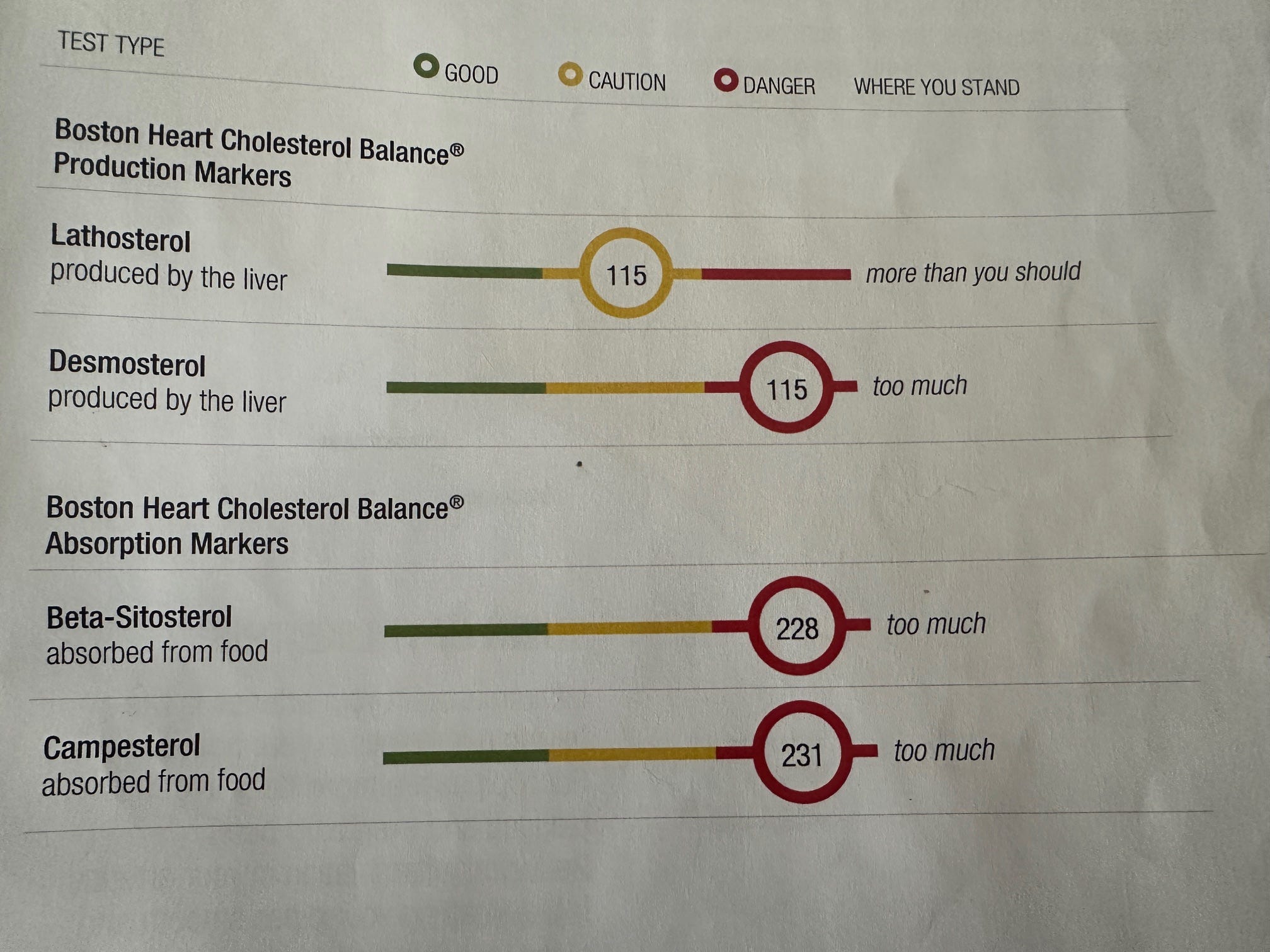
As you can see above, not slightly - meaningfully. My cholesterol markers on this same test were Total Cholesterol 209, LDL-C 123, ApoB 103. Based on my goals today, everything was high - yet - for many folks not far off.
The Flaxseed Problem (for Some of Us)
Flax is often praised for:
Fiber
Lignans
Omega-3 (ALA)
But it is also one of the highest dietary sources of plant sterols.
For a hyperabsorber, that matters.
In my case, what I thought was:
“I’m supporting my brain”
…was likely contributing to a risk exposure I was oblivious to.
Why You Should Know Your Pattern
This isn’t about demonizing healthy foods.
It’s about matching the input to your biology.
Two people can eat the same “clean” diet and have very different outcomes.
If you:
Have persistently elevated LDL or ApoB despite a clean lifestyle
Don’t respond well to statins alone
See a strong response when adding ezetimibe
Eat a diet high in nuts, seeds, and plant fibers
…it may be worth asking whether absorption - not production - is driving your numbers.
You Don’t Have to Guess
Ideally, this is tested.
The most direct way I’ve found is by measuring:
Campesterol
Beta-sitosterol
Lathosterol
These markers help distinguish between cholesterol absorption and cholesterol production.
I used Boston Heart Diagnostics for this since most labs can’t test it. Even Emory University Hospital in Atlanta does not have a test to determine absorber status! But regardless of how you test, understanding your pattern can be a turning point.
The Takeaway
Health is not about doing more.
It’s about doing what matches you. For years, I was eating something, touted as a fantastic health food - and I was likely doing damage in the process.
Not everything that is “healthy” is healthy for everyone.
And sometimes, the most important step forward… is correcting what you’ve been doing all along.
If you carry APOE4 - or are working to optimize your cardiovascular and brain health - this is one area worth understanding.
Because the difference between absorption and production isn’t subtle.
It changes everything.
Another great benefit of this test, Karin, is that it measures your level of desmosterol. This can help people before they start statin therapy, as, if they are naturally low in desmosterol, it's a "no-brainer" that a statin will likely plummet their desmosterol even lower...which is no bueno! Great test!
So now that you know that you know this, what are you doing to correct it? I am going to get this tested as my recent labs came back super high -- way higher than yours.....although I was having MCT oil and butter daily - now I've cut both out completely.....Is ezetimibe the solution for you? I'm looking into that, even though I really really don't want to be taking a drug.......