
I want to share something that has genuinely changed my life - particularly my metabolic health.
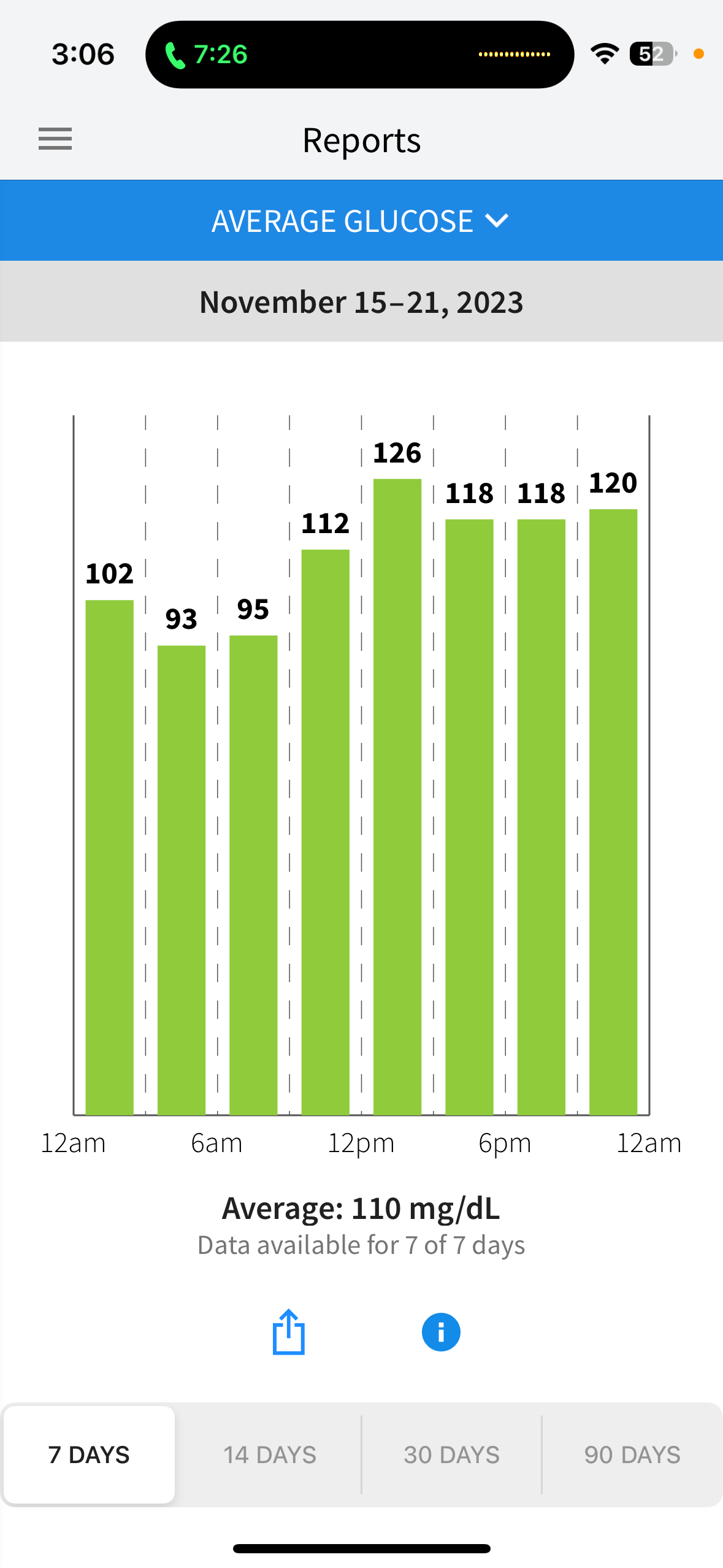
In 2023, my HbA1c hovered around 5.5%, just one decimal point shy of being labeled pre-diabetic. That number alone was enough to push me into action. I decided to wear a CGM (continuous glucose monitor) because I wanted to understand what was actually happening beneath the surface - and why, despite what I believed were healthy food choices, my A1C was this high.
What I saw was sobering.
My average glucose was around 110 mg/dL, and foods widely considered “healthy” - apples, bananas, even very modest portions of starch - sent my glucose soaring. Seeing those spikes in real time was a shock. I had no idea how frequently my glucose was being yanked upward, despite what I thought was a careful, whole-food diet.
The Cost of “Doing Everything Right”
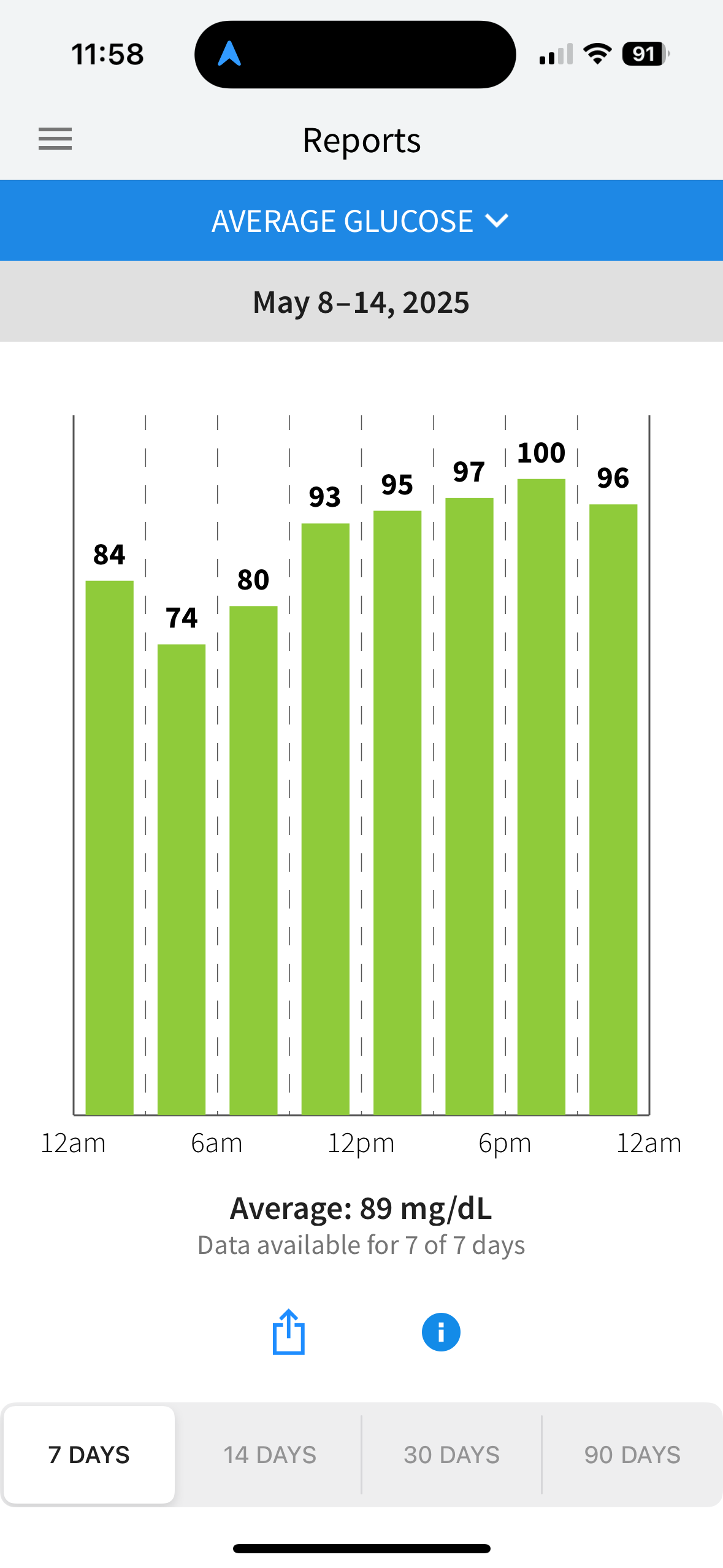
By 2025, I managed to bring my average glucose down to about 89 mg/dL (CGM reading below) - but the price was steep.
I achieved those numbers only by becoming extremely restrictive:
avoiding entire food groups
eating very little variety
constantly anticipating spikes
and, ultimately, losing weight I couldn’t afford to lose
On paper, my metabolism looked much better.
But my 5’7” frame was beginning to look uncomfortably thin as my weight dipped below 120 lbs.
By late summer last year, I made a hard but necessary decision: I would stop trying to improve insulin sensitivity temporarily and focus solely on regaining weight. Being underweight was a more immediate health risk than a borderline A1C.
Letting Go of the CGM (and the Rules)
In August, I stopped using my CGM altogether. I stopped checking finger sticks. I stopped worrying about spikes.
I ate anything I wanted - as long as it was whole food. And yes, I broke some rules. Even Ice cream made a few appearances… So did bread. And during the holidays, I happily worked my way through a huge box of German Christmas treats - Lebkuchen, chocolate-covered pretzels, pralines - sent by a business associate from across the pond.
Not seeing glucose spikes in real time didn’t mean they weren’t happening.
But my priority was clear: restore weight first, worry about A1C later.
What happened next surprised me more than anything I’ve seen in years of health and biometrics tracking.
January 2026: A Stunning Surprise
I hadn’t worn a CGM since mid-2025. I hadn’t checked my A1C since October, when it was still sitting on the cusp. Now that I was close to my weight goal, I decided to put a CGM back on - fully expecting to see damage from five months of relaxed eating.
Instead, I was stunned.
On day one, my glucose stayed steady and low….didn’t peak over 130 mg/dL all day. I was suspicious the CGM was “off” since I expected to see the usual averages. I double-checked this with finger-prick tests - the CGM was accurate. Over the following days, my surprise escalated to something close to disbelief.
My insulin sensitivity had dramatically improved.
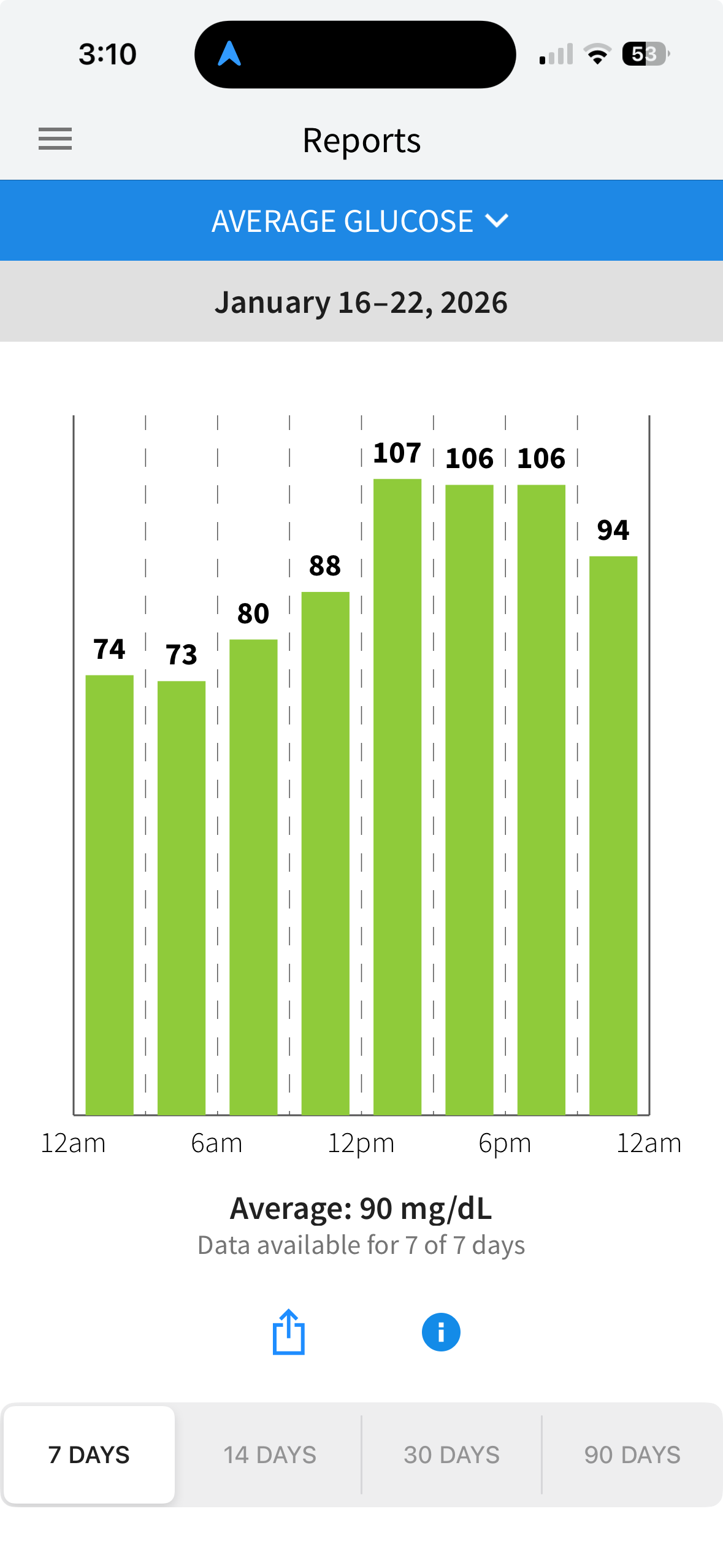
Today, my average glucose sits around 90 mg/dL:
without restriction
without fear
without hyper-vigilance
and without worrying about weight loss
I went from an average glucose of ~118 mg/dL in October to ~90 mg/dL in January.
A bowl of steel-cut oats — which would have spiked me to 170–180 mg/dL last year — now barely reaches 130 mg/dL. My morning glucose, once in the low 90s, is now typically in the low 70s.
What Changed?
Two things - and they likely matter together.
1. Saffron (Yes, Really)
I didn’t discover saffron through a paper or a podcast.
In October, while visiting Turkey, my husband and I wandered into a spice shop in the Grand Bazaar, in Istanbul. The shop owner enthusiastically explained saffron’s benefits - mood, inflammation, vitality - and then casually added:
“It’s a potent spice to regulate insulin.”
That phrase got my attention!
Given how close my A1C was to the prediabetic range, we figured: why not try it? We bought an 8-ounce bottle of saffron threads to take home.
We began drinking a simple daily “tea”:
10–12 saffron threads, steeped in hot (not boiling) water for 20 minutes.

No expectations. No protocol. Just curiosity….and I’d actually forgotten why we were even drinking it!!
2. C8 MCT Oil (The Quiet Enabler)
Around the same time (October 2025), there was one other change to my routine. I began adding one teaspoon of C8 MCT powder to the two cups of morning coffee I drink daily.
C8 doesn’t lower glucose directly. Instead, it provides rapid ketone fuel, reducing reliance on glucose and improving metabolic flexibility. In hindsight, it likely helped stabilize my baseline, flatten curves, and buffer glucose excursions - creating fertile ground for saffron’s effects to shine.
What I’m Seeing Now
Since adding saffron and MCT C8 powder, my glucose response has fundamentally shifted over the last few months - in a way I could only have dreamed of last year.
Foods that once guaranteed spikes - pasta, potatoes, bread, even a chocolate praline - now produce modest, well-contained responses, with faster recovery and smoother curves. Peaks generally stay under 130 mg/dL, often much lower depending on food and combination (order of eating).
Even more remarkable:
My post-meal glucose reliably drops back under 100 mg/dL within ~90 minutes
My fasting glucose is now typically in the low 70s
Overnight glucose is flat and stable
Overall variability is dramatically reduced
My glucose metabolism is no longer being managed into submission.
It’s doing what it’s supposed to do again. This is metabolic resilience and I’m delighted it found me entirely by chance in an Istanbul spice bazaar.
How Might Saffron Be Doing This?
Improved insulin sensitivity
Saffron’s bioactive compounds (notably crocin and safranal) appear to enhance GLUT4 translocation, improving glucose uptake in skeletal muscle.Reduced stress-mediated glucose release
Saffron influences stress and cortisol signaling - critical, because stress alone can drive post-meal glucose elevations.β-cell protection
Evidence suggests saffron reduces oxidative stress on pancreatic β-cells, potentially improving first-phase insulin response.Central glucose regulation
Saffron also acts in the brain, influencing glucose sensing and appetite signaling - an often-overlooked layer of glucose control.
A Final Word
Everyone responds differently.
This is N=1
But I would be remiss not to share something that has been genuinely life-changing for me.
Maybe saffron is under-explored simply because of its cost in the U.S. I don’t know. What I do know is that I’ll be eternally grateful to a spice merchant in Istanbul who insisted I take some home.
When I put on a CGM a few weeks ago, I had almost forgotten about him - until I found myself scrambling for an explanation as to why my average glucose dropped so obviously and dramatically - despite breaking all my usual dietary rules for months!
Sometimes the biggest shifts come from the least expected places.
Nature is a beautiful thing and yes, plants can be the most effective medicine!
Disclaimer:
This is my personal, N=1 experience and not medical advice. Responses to saffron, C8 MCT oil, and dietary changes can vary significantly between individuals. Those with diabetes, reactive hypoglycemia, eating disorders, or who use glucose-lowering medications should consult a qualified healthcare professional before making changes.
Great question Karin — here is what CHAT GPT says
Big picture first
• Yes, MCTs (medium-chain triglycerides) are absorbed directly into the portal vein and go straight to the liver, unlike long-chain fats that get packaged into chylomicrons.
• Because of that, they tend to have less post-prandial lipemia and less immediate impact on LDL than saturated long-chain fats.
• But… “less” does not mean “none,” particularly in APOE4 carriers.
APOE4 + MCTs
• APOE4 individuals are more sensitive to saturated fat, even shorter-chain ones.
• Several lipidologists (and plenty of N=1 data) have seen LDL-C and ApoB rise in some APOE4 carriers using MCT oil or powder.
• The liver can convert excess MCTs into acetyl-CoA → cholesterol and VLDL, especially if total caloric intake is high or insulin resistance is present.
C8 vs C10 vs “generic” MCT
This is where nuance matters:
C8 (caprylic acid)
• Most ketogenic
• Rapidly oxidized
• Least likely of the MCTs to raise LDL
• Shorter half-life, less incorporation into lipoproteins
C10 (capric acid)
• Still MCT, but behaves a bit more like long-chain fat
• More likely to raise LDL than C8
C12 (lauric acid)
• Not really an MCT physiologically
• Clearly raises LDL (especially in APOE4)
👉 If an APOE4 patient is going to use MCT at all, C8-only is the safest choice.
MCT oil vs MCT powder
• Powder = MCT oil + carrier (usually acacia fiber or tapioca-derived starch)
• Lipid effects come from the fat itself, not the form
• Powder may blunt absorption slightly, but does not eliminate LDL effects
Practical advice I usually give
For APOE4 carriers:
• ✅ Prefer C8-only
• ✅ Keep dose low (e.g., 5–10 g/day, not 20–30 g)
• ✅ Use in a metabolically healthy context (exercise, low refined carbs)
• ❌ Avoid if LDL-C, ApoB, or LDL-P rise meaningfully
• 📊 Check ApoB after 6–8 weeks — that’s the arbiter
Bottom line
• Your instinct is right: portal vein transport does reduce—but does not eliminate—LDL effects
• C8 is “less bad,” not “neutral,” in APOE4
• In APOE4 carriers chasing metabolic or cognitive benefits, I treat MCTs as a trial with labs, not a free pass
Excellent! My morning glucose has been in the low 90s. I asked AI about it, and it said yeah, that's common in keto and fasting and nothing to worry about - just your body adjusting. I had been thinking of adding MCTs again... and also saffron. You gave me the go-ahead! Good story!