
CETP - The Lipid Traffic Controller
In simple terms, most of us think of cholesterol being either good or bad. While we have focused on LDL as the bad guy and HDL as the good guy, less attention has been paid to their dance with each other.
Cholesterol is constantly being transported between tissues, cells, and organs and the efficiency of that movement is likely more important than the lipoprotein on its own.
Think of:
HDL as the recycling truck
LDL as the delivery truck
CETP as the traffic controller deciding where cholesterol moves next
CETP’s job is to exchange:
cholesterol esters from HDL
triglycerides from LDL and VLDL
Every second of every day.
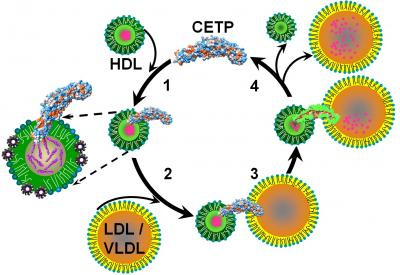
Why CETP Exists
This is the fascinating evolutionary question.
Researchers believe CETP probably evolved because:
humans often faced starvation
dietary fat availability fluctuated
rapidly redistributing cholesterol may have improved survival
it likely supported steroid hormone production and immune responses during infection
So, in effect :
CETP was designed to keep people alive in times of scarcity of food - much like APOE, it isn’t nearly as important in a modern man’s lifelong exposure to food access on demand and abundant calories!
The Two prominent CETP Variants to know - especially as an APOE4 carrier
rs708272
Genotype: B1/B1 (G/G)
more CETP
lower HDL
Genotype B2 carriers (A/A or A/G)
less CETP
higher HDL
rs3764261
Probably the most important HDL SNP.
The A (T) allele has:
lower CETP expression
higher HDL
lower CAD risk in many studies
The C (G) allele
higher CETP
lower HDL
Why More CETP Usually Looks Bad
Higher CETP generally means:
Lower HDL
Less efficient reverse cholesterol transport
Higher ApoB particles
Higher LDL cholesterol
Higher inflammation
Higher cardiovascular disease risk
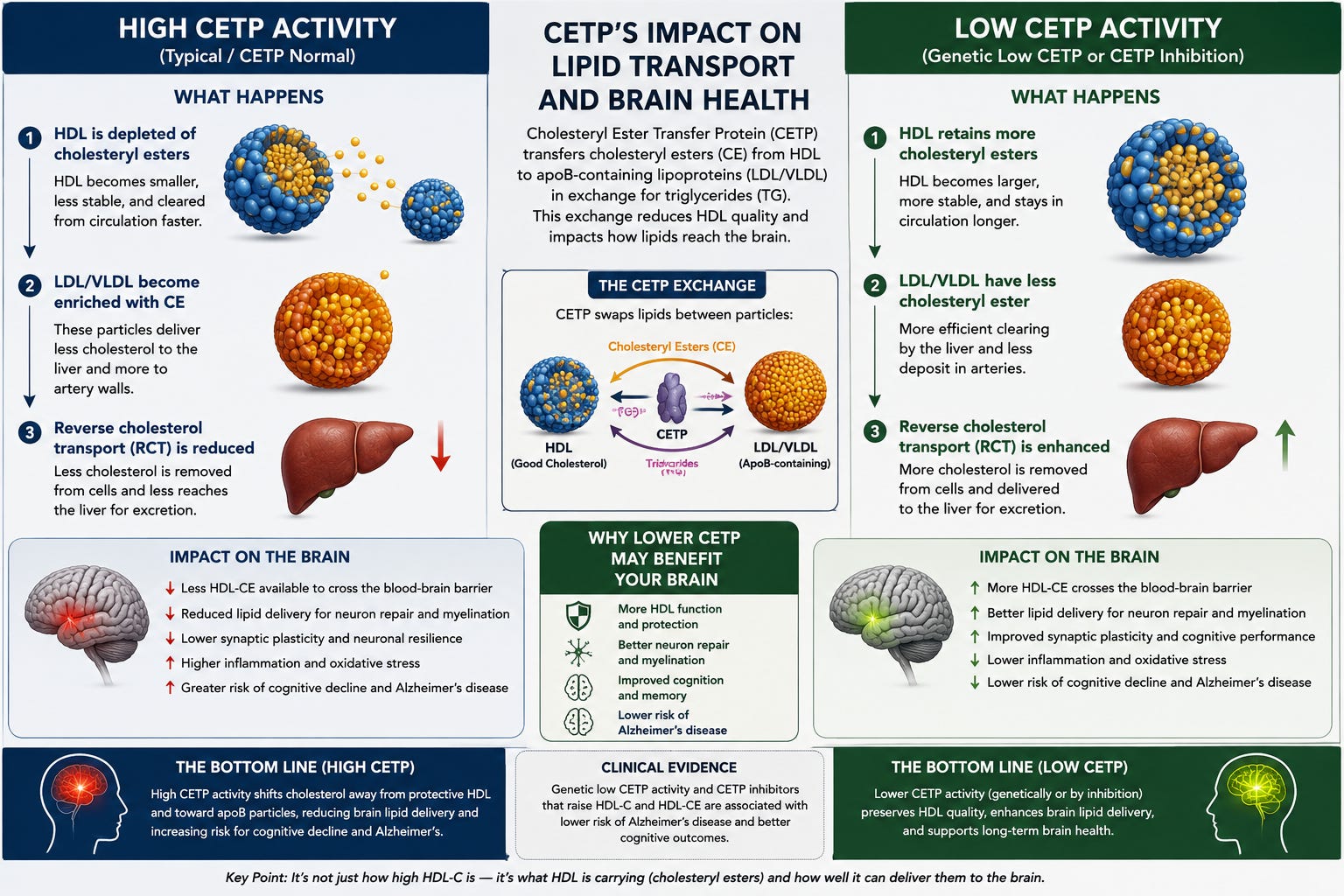
What does APOE have to do with CETP?
ApoE transports cholesterol inside the brain.
APOE4 already transports cholesterol less efficiently.
Now imagine adding:
High CETP activity driving less functional HDL, less cholesterol recycling and less neuronal repair - potentially leading to higher dementia risk.
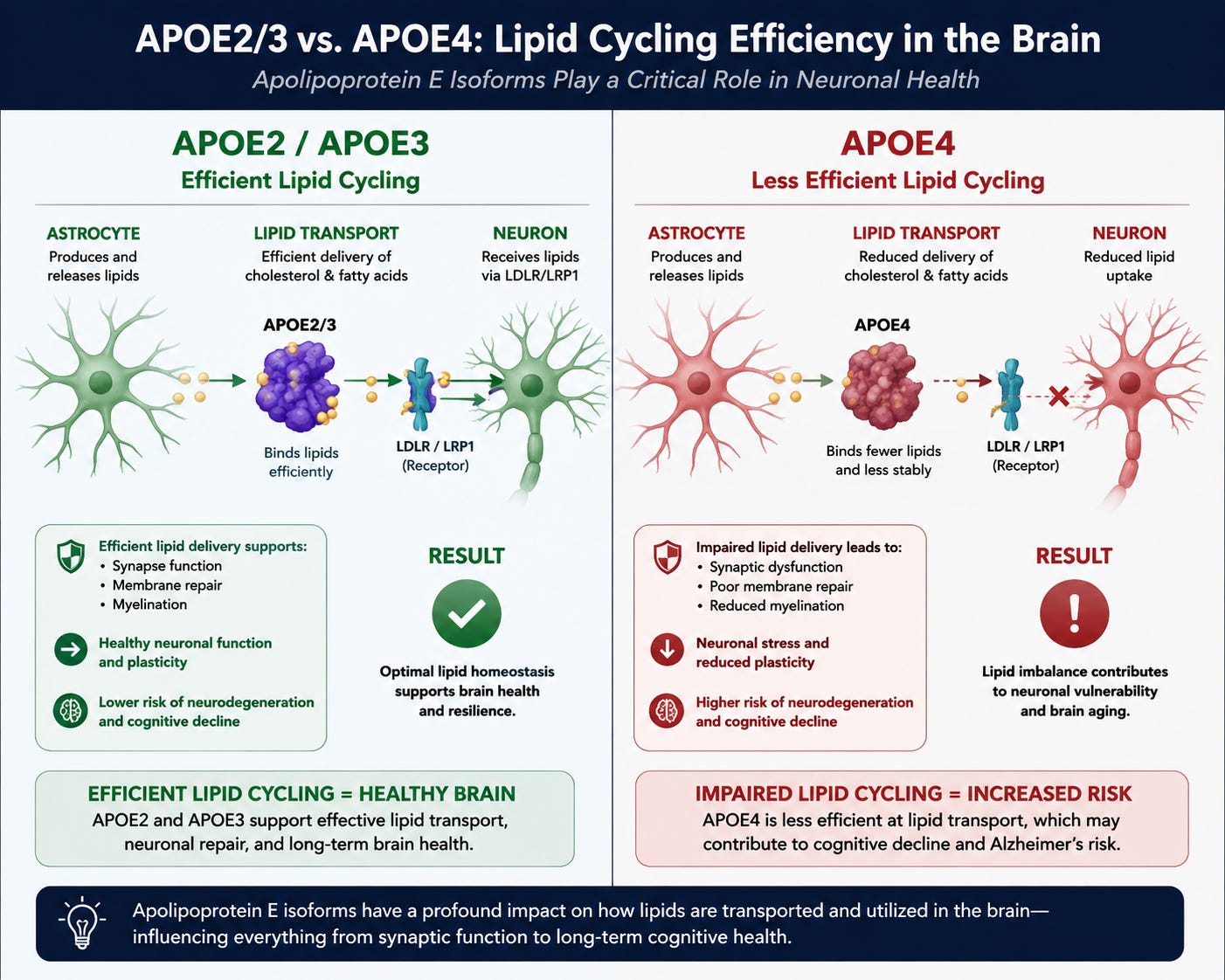
What Human Genetics Tells Us
One of the most compelling pieces of evidence:
People born with CETP variants that reduce CETP activity generally have:
HDL 10–25% higher
lower cardiovascular disease risk
often longer lifespan
no major syndrome from lifelong partial CETP inhibition
Nature has already shown that lower CETP levels are not detrimental. While I carry the “normal CETP” level gene variants, my mother - who attained the age of almost 96 with no cognitive shortfalls until her early 90s, was heterozygous on both genes referenced above.
CETP Inhibitor Drugs: A Rocky History
Torcetrapib failed - not because CETP inhibition itself was ineffective, but because the drugs had undesirable side effects (including raising blood pressure and aldosterone).
Other proposed drugs stumbled for different reasons:
dalcetrapib: modest efficacy
evacetrapib: trial stopped early
anacetrapib: effective but not pursued because of extremely long tissue retention
The lesson wasn’t that CETP is a bad target. It was that finding the right drug proved difficult.
A Shining Star On The Horizon: Why Obicetrapib Is Different
Here’s where the excitement builds.
Obicetrapib produces approximately:
LDL reduction of ~45%
ApoB reduction of +/- 20%
HDL increase of ~150%
Lp(a) reduction of up to 45%
It appears more potent than earlier CETP inhibitors and, so far, has shown a favorable safety profile in clinical trials. It is well-tolerated with no side effects that stand out compared to the placebo group.
Why This Matters For Those Of Us Carrying APOE4
APOE4 impairs lipid transport in the brain.
CETP influences HDL remodeling and reverse cholesterol transport.
Reduced CETP activity may improve the availability of cholesterol needed for neuronal repair.
Obicetrapib is one of the first therapies capable of dramatically modifying this pathway.
That biological rationale is why it’s attracting a lot of interest as a potential disease-modifying strategy for APOE4 carriers. And, considering it saw a 20% reduction in ptau217 levels in APOE4 carriers, it’s definitely one that gets my attention!
After spending hundreds of hours reviewing the literature on APOE4, CETP, Lipid biology, statins, and now Obicetrapib, I've reached a conclusion that has fundamentally changed how I think about Alzheimer's prevention.
APOE is, first and foremost, a cholesterol transport protein. Increasingly, the genetics, the basic science, and now the emerging drug development all point in the same direction: impaired lipid transport and cholesterol handling are a common denominator.
That doesn’t mean cholesterol is the only mechanism driving Alzheimer’s risk in APOE4 carriers. Inflammation, vascular dysfunction, immune activation, mitochondrial health, and protein clearance all matter. But cholesterol metabolism increasingly looks like the hub from which many of these downstream effects arise.
I cannot say with certainty that lowering LDL-C, ApoB, or improving HDL function will prevent Alzheimer’s. No one can - not yet. But based on everything I’ve read, I would be far less comfortable ignoring elevated LDL as an APOE4 homozygote than I would have been five years ago. The evidence has shifted enough that, for me, the risk of doing nothing now seems too high.
My Thoughts
I’ve followed Alzheimer’s research for years, and few drugs have generated this level of interest for me. Obicetrapib isn’t exciting simply because it lowers LDL or Lp(a). It’s exciting because it targets a pathway that intersects with APOE biology, cholesterol transport, and brain health. We don’t yet know whether it will prevent Alzheimer’s - but it’s one of the most biologically plausible approaches currently being tested - and I’m super excited!
Interesting related links:
The emerging role of CETP inhibition in the prevention of Alzheimer’s disease
Lower activity of cholesteryl ester transfer protein (CETP) and the risk of dementia
AI Disclosure: I use AI to help explain complex medical and scientific concepts, edit my writing, and reduce the time it takes to produce these free articles. That said, AI is only as good as the prompts and context it's given, so my queries are laser-focused, detail oriented and posed through the lens of APOE4. I cross-check important information across three different AI platforms, and verify it against the published literature to insure accuracy. Used well, it's an extraordinary research tool. Used poorly, it can be superficial, verbose, and a waste of time
Hi Karin , great write up and especially liked the detailed gene info as I have had ultra deep full genome study and e4/4 , so very actionable. Am on the case to get it once released eu. Well done, thanks.
Great write-up, and putting the CETP-inhibitor graveyard right next to obicetrapib is the honest way to make the case.
The part that reframes it is the endpoint: torcetrapib and the rest were judged on cardiovascular outcomes, but a 20% drop in ptau217 in APOE4 carriers is a different bet entirely, scored on brain biology rather than lipids. That also makes it testable on a biomarker timescale instead of waiting years for hard outcomes. The lipid-versus-protein-pathology framing is the useful takeaway.